San Clemente Times: Levin Highlights Rail, Beach Restoration and San Onofre During San Clemente Town Hall
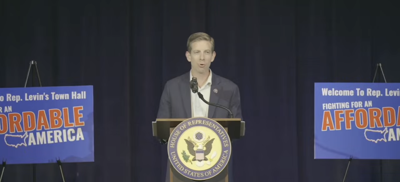
Rep. Mike Levin addressed coastal erosion, rail stability, nuclear waste, rising energy costs and other local and national issues during a town hall at San Clemente High School on Friday, Aug. 28.
The event marked Levin’s 138th town hall since entering Congress, continuing a commitment he said he made after first being elected in 2018 to regularly meet with constituents and answer questions directly.
Levin thanked San Clemente High School for hosting the event and recognized local elected officials in attendance before providing updates on several issues affecting South Orange County.
Among the most prominent local topics was the Los Angeles-San Diego-San Luis Obispo rail corridor, which has faced repeated disruptions in San Clemente because of coastal erosion and slope instability.
Levin said that when the closures during his time in Congress are combined, the rail line has been shut down for nearly the equivalent of a full calendar year.
“We can’t keep lurching from one emergency closure to the next,” Levin said. “We’ve got to protect the tracks and keep the trains running safely now, while doing the harder work of developing a lasting solution.”
He pointed to the importance of the corridor for passenger travel, freight and military operations, as well as the additional strain closures place on Interstate 5.
Levin also tied the need for reliable transportation infrastructure to the 2028 Olympic Games, when surfing competition is expected to bring visitors to the area.
He highlighted a $100 million federal grant secured for the Orange County Transportation Authority to improve and protect the San Clemente portion of the rail corridor, along with additional federal funding for long-term planning.
Beach nourishment remains another component of protecting the tracks, Levin said.
Working with the city and U.S. Army Corps of Engineers, Levin said $16.7 million in federal funding was secured to complete the first two phases of the San Clemente Shoreline Project.
The project has placed nearly 200,000 cubic yards of sand and widened portions of the city’s beaches by as much as 50 feet, according to Levin.
The work represents the beginning of a long-term federal commitment to San Clemente’s coastline.
“These were just the first two phases of a 50-year commitment from the Army Corps,” Levin said, adding that he intends to use his position on the House Appropriations Energy and Water Subcommittee to advocate for continued funding.
The discussion later turned to another longstanding issue for San Clemente: spent nuclear fuel stored at the decommissioned San Onofre Nuclear Generating Station.
Asked by a constituent about efforts to remove the waste, Levin discussed his work on a consent-based approach to finding communities willing to host spent nuclear fuel and related facilities.
Levin said the federal government has spent years examining how to create a system in which communities and states voluntarily participate in the nuclear fuel cycle rather than having a storage site imposed upon them.
He also discussed the Spent Nuclear Fuel Solutions Caucus, which he helped establish with Republican Rep. Chuck Fleischmann of Tennessee, as well as federal investments in transportation technology needed to eventually move the waste.
Levin said roughly $150 million has been directed toward spent nuclear fuel transportation, research and related efforts during his time in Congress, including approximately $33 million for the Atlas rail system designed to transport spent fuel.
Several states have also expressed interest in participating in efforts related to the nuclear fuel cycle, Levin said.
Once a destination for the nation’s spent fuel is established, Levin argued that San Onofre should be among the first sites considered for removal because of its location near a large population, the coastline, seismic hazards and other environmental and security concerns.
“We have to make sure that because all those things are true about our location, that we’re prioritized when we have a disposition of where the spent fuel will go,” Levin said.
Rising utility and gasoline prices were another focus of the evening.
Levin said local families have experienced significant increases in electricity costs in recent years while also facing high housing, grocery and health care expenses.
He cited a combination of factors contributing to higher energy costs, including global instability, increased electricity demand from data centers, an aging power grid, extreme weather and exposure to fluctuating oil prices.
Levin said he is co-leading a congressional Gas and Utilities Affordability Working Group and has introduced the Energy Bills Relief Act, which he said is intended to expand access to lower-cost energy, modernize the electrical grid, provide assistance to households and prevent large energy users such as data centers from shifting costs onto other customers.
Aaron McCall of California Environmental Voters joined Levin during the town hall to discuss California’s energy prices and potential approaches to reducing costs.
Levin also addressed concerns surrounding a cluster of rare childhood cancer diagnoses in Ladera Ranch.
He said six children have been diagnosed with Ewing sarcoma and at least one with synovial sarcoma, prompting questions from families about whether environmental factors could be involved.
Levin cautioned against reaching conclusions before scientific reviews are completed but said he has formally requested an Environmental Protection Agency investigation into potential environmental factors, including pesticides used in and around the community.
The EPA has indicated it is working with state and local officials, Levin said, though he added that more investigation is necessary.
“We need a full investigation that follows the science wherever it leads,” Levin said.
Levin additionally discussed concerns about conditions aboard the USS Abraham Lincoln following an extended deployment.
He said families of service members had reported problems involving food, running water, plumbing and other living conditions aboard the aircraft carrier. Levin said he and other members of Congress have called for an independent investigation into the conditions and how concerns were handled.
During the constituent question-and-answer portion of the town hall, attendees raised issues ranging from Social Security and immigration to artificial intelligence, voting rights, the Supreme Court and U.S. military involvement in Iran.
On Social Security, Levin said he supports raising the payroll tax cap for higher earners rather than cutting benefits or increasing the retirement age. He cited the Social Security 2100 Act and said he supports applying the tax again to income above $400,000 as part of efforts to extend the program’s solvency.
Another constituent asked Levin about federal oversight of artificial intelligence.
Levin said Congress needs comprehensive bipartisan legislation addressing AI’s effects on the workforce and education as well as guardrails involving political advertising, exploitation, model safety and data centers.
He acknowledged the pace of technological development has outstripped the speed at which Congress traditionally acts and said lawmakers are participating in working groups and exercises aimed at developing a broader federal framework.
The discussion also turned to the country’s economic outlook and the growing federal debt.
Levin described the roughly $40 trillion national debt as unsustainable and argued that addressing it will ultimately require both spending reductions and additional revenue. At the same time, he said policymakers should evaluate programs based on their long-term return, pointing to investments in infrastructure, education and children as areas that can produce broader economic benefits.
He also highlighted housing affordability as a major challenge in Orange County, particularly for younger residents and those who do not already own homes.
“The stock market is not the economy,” Levin said, noting that rising home values can benefit existing homeowners while making it increasingly difficult for others to enter the housing market.
Toward the end of the town hall, Levin was asked about what he considers some of the most consequential long-term challenges facing the country and the world.
He pointed to nuclear proliferation, climate change and extreme weather and the rapid emergence of artificial intelligence.
Levin closed the nearly hour-long event by thanking residents for spending their Friday evening participating in the town hall and encouraged continued involvement with local government.
“You’re here with me because you care about this community,” Levin told attendees.
Levin said he plans to continue the town hall series with a 139th event.